
Hockley was born in Philadelphia, the namesake of the United States’ first president. A young boy during the War of 1812, he became enthralled by military affairs and around 1823 moved to Washington D.C. to work as a clerk at the War Department.
While in Washington he befriended Sam Houston—at the time a Tennessee Congressman. Hockley moved to Tennessee soon after, eventually following Houston all the way to Texas. He joined the Texas army in December of 1835.
Hockley, a notoriously thorough man, was made Inspector General of the Army. During the Runaway Scrape, Hockley was in charge of managing artillery, supplies and recruiting efforts.
Houston’s series of retreats across the region caused much grumbling among the Texian fighters whose homes and families had been displaced by the invading army. But Hockley's devotion to his leader—and long-time friend—never wavered.
The day before the Battle of San Jacinto, during a brief skirmish, Colonel James C. Neill was injured by Mexican gunfire. Hockley would take Neill's place commanding the Texian artillery.
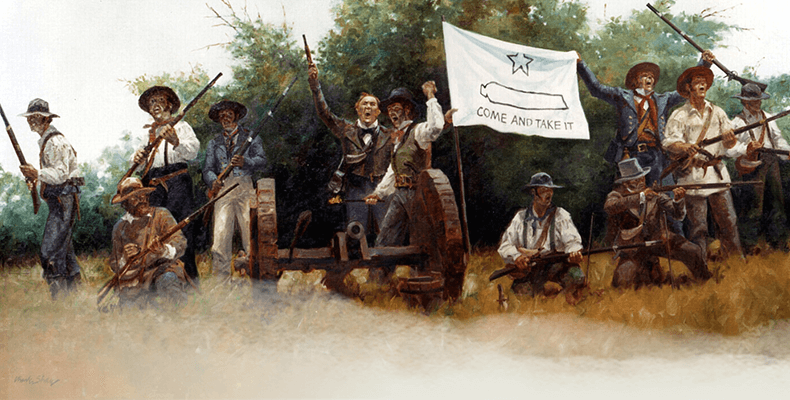
He did an admirable job managing the only Texian artillery on the field, the famed “Twin Sisters”—two cannons donated by the City of Cinncinatti, Ohio for use in the revolution. Hockley ripped enemy lines with cannon fire, and aided General Houston when he was shot in the ankle.
Hockley diffused hotter heads that suggested a less-than-honorable fate for General Santa Anna within five minutes of his capture. Hockley accompanied Santa Anna and Juan Almonte to their meeting with Andrew Jackson at the U.S. Capitol.
After San Jacinto, Hockley served Texas in a number of roles including Secretary of War. Granted almost 2,000 acres of land for his service to his country, he spent his latter years as a farmer, jockey and land speculator. He died in 1854 while visiting a friend in Corpus Christi.