
Texian Commanders
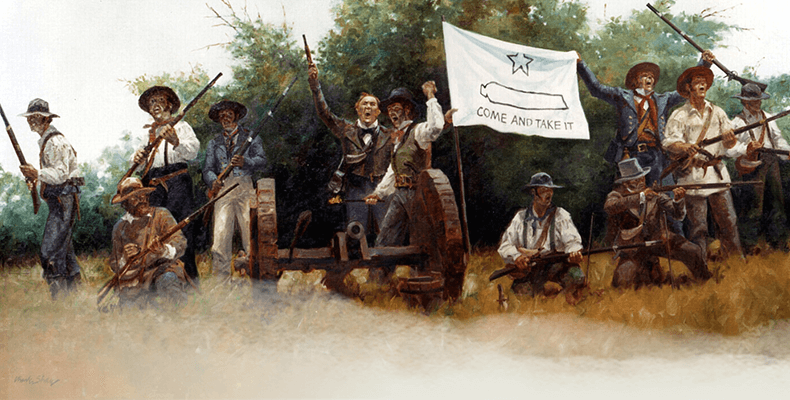
The Texian commanders under Sam Houston at San Jacinto were not afraid of risk. But their path to soldiering differed from that of Santa Anna’s leaders. Many of them were not career soldiers but businessmen, politicians or farmers. They were used to shooting squirrel or deer, not sentries or sergeants. But they didn’t fear the battlefield—especially when the livelihoods of their families were at stake.
Mexican Texas was not stable or populous—but it did hold vast opportunity to make a fresh start and acquire generous amounts of land. All sorts of Americans and Europeans came to Texas to swear allegiance to Mexico and a new way of life. Gone to Texas, or GTT, was painted in bold letters on houses from Missouri to Maine. But they didn’t strictly come from a military background.
Thomas Rusk, for example, chased a group of swindlers who cheated him on a mining investment from Georgia to Texas where he became active in Texas independence. Mirabeau Buonaparte Lamar, who commanded the Texian cavalry at San Jacinto, was by trade a senator and a skilled poet.
Edward Burleson had military experience that included the war of 1812, but most of his career was spent as a militiaman. Sidney Sherman, too, was a militiaman and entrepreneur who saw wide potential in Texas’ future. He’d made a fortune and used his money to outfit a fighting unit for the Texas Revolution.
Henry Millard, who led two infantry companies at San Jacinto, was a land speculator by trade. George Hockley, Texas Army chief of staff, had more experience than most, having worked at the United States War Department in Washington D.C.
Up until 1835, Juan Seguín had been a professional politician.
On the most part, these were not graduates of West Point or the Brienne military school routinely doing a day’s martial work. These were rebels. But all had also seen too much potential in Texas to leave it’s future to fate.