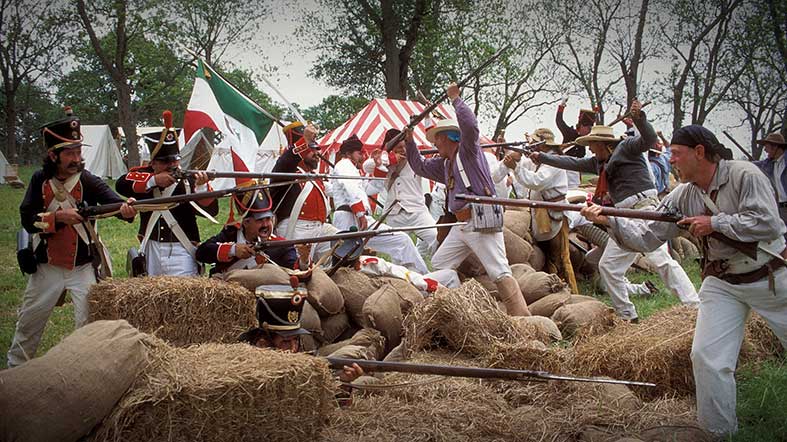

Though its ownership switched a few times, life in Mexican Texas during the 1830s hadn't changed much since the days of the Paleo-Indians (around 9000 BC). It was a hard life, even for wealthy citizens: Subsistence farming. Barter. Threats from rival tribes.
The first Europeans to walk on Texas soil were the Spanish. By 1530, they were exploring the area as a small part of the larger Spanish campaign to colonize the whole of the Americas.
With the establishment of missions in the 1600s, the Spanish maintained a strong presence in the area for two centuries. While their global rivals, the French, would prove no competition in Texas, the indigenous population would not be stifled forever.
 |
 |
 |
 |
| The Mexican Revolution brought new ownership to the region. |
 |
 |
 |
| San Jacinto Museum of History � 2003 |
 |
 |
 |
 |
 |
 |
 |
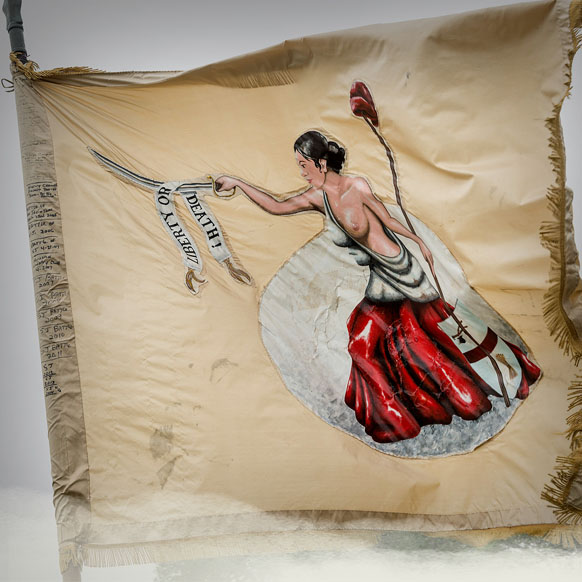
In 1810 Mexicans voiced discontent with their Spanish overlords through regional revolts. And in 1821, Mexico declared independence from Spain in one of many rebellions against Spanish colonizers. A new flag flew over Texas. And it brought new opportunities to its American neighbors.
To buffer this new nation's North from foreign aggression and hostile Indians, the Mexican government drew European and American settlers to the area. Through a rigid system of formal administration, settlers were granted vast land holdings and exempted from taxes.
These grants were eventually laid forth in the National Colonization Law of August 18, 1824. It was a Federalist system, granting a liberal degree of autonomy to regional government. All new settlers had to do was promise to become citizens, obey the laws, and worship as a Catholic. New arrivals could get almost 5,000 acres!
 |
 |
 |
 |
 |
Generous land grants drew floods of Americans to Mexican Texas. They brought along their entrepreneurial spirit. |
 |
 |
 |
San Jacinto Museum of History � 2003 |
 |
 |
 |
 |
 |
 |
Americans came in droves. But they brought a new culture. And political changes in mainland Mexico would destroy their loyalty and change their intentions.
By the late 1820s, the Mexican government began restricting American immigration, and grew tired of the immigrants' lax application of their laws. By 1829, the Federalist Mexican government was displaced by Centralists, who demanded central authority and voided much of the 1824 Constitution.
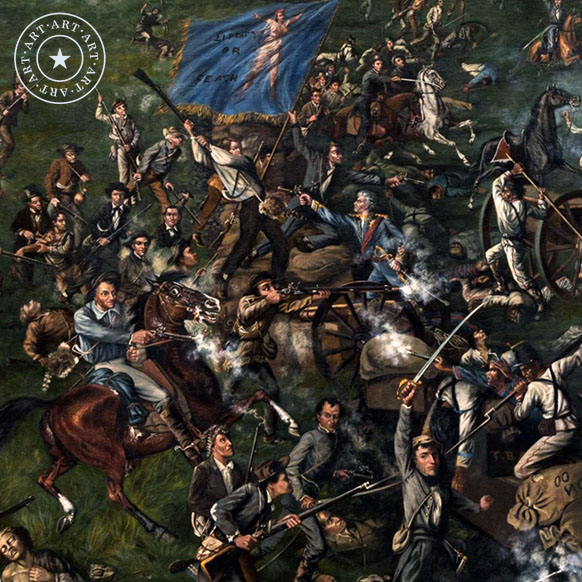
When the Centralist government set forth to enforce its policies in Texas, relations between the Mexican government and American colonists quickly decayed. From the first surprise of Gonzales to the conflict at Goliad and the legendary siege at the Alamo–both sides would fight for their cause.
The result of these events can be seen not just on a modern map of the United States, but also in the cultures comprising contemporary America. Today, Mexican and American cultures in Texas are intertwined, their histories spinning on an axis near present-day Houston: The San Jacinto Monument..