
Making a Mark, Leaving a Legacy
Opening November 12, 2011.
An exhibit that looks at the tools that have traditionally been used to make a mark, the people that have left a mark on our region and the symbols that our predecessors used to convey important ideas and concepts.

A mark can be defined as many things. It can be a visible impression or a trace left behind on something and be either tangible or intangible. It can also be an impressed device, or a symbol or inscription that is designed to give information, identify, indicate origin or ownership or attest to character or comparative merit. It can be a recognized or required standard of quality or an object or goal that is striven for. Some marks last for a brief time and leave little or no impression upon the landscape. Others—the ones that we explore in this exhibit—have left an impression, sometimes physical, sometimes abstract and more difficult to detect, and a few have had their meaning change or be lost to time. Making a Mark, Leaving a Legacy shares some of the stories behind the creation, use, interpretation, discovery and display of many well known and some not so well known artifacts from the collections of the San Jacinto Museum of History.
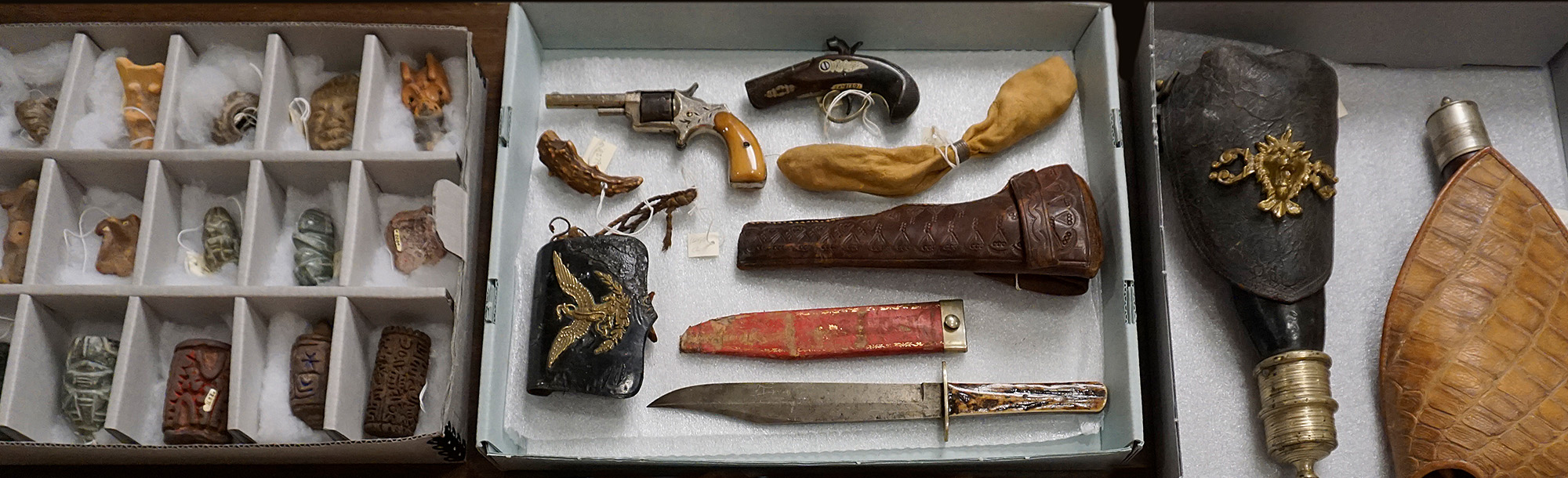
A Mexican seal fashioned from crystal and brass that bears the seal matrix from the 19th century Department of Agriculture. A Pre-Columbian clay stamp that prints the features of an odd, fantastic creature. A rubber stamp that celebrates the opening of the San Jacinto Monument. A calling card and the copper plate used to print it from Texan Stephen F. Austin. These artifacts represent some of the more obvious examples of how artifacts have left physical marks throughout the region’s history. Whether used to announce a person’s presence or mark an important event, decorate a surface, or prove authenticity, these tools and others like them have been used for centuries (and are still used in more modern forms) to make a mark that communicates both its creator’s and user’s message.

One of the highlights of the exhibit has been lying in the basement of the San Jacinto Museum for over seventy years. The wax bust of Sam Houston, weighing in at over seventy pounds and over thirty inches in height, was a treasure of the collection that was seen by very few members of the public. Crafted by the noted sculptor and designer of Mount Rushmore, Gutzon Borglum, in the 1930s and brought to the museum soon after it was opened by Texas historian and museum Board member Louis Wiltz Kemp, the bust proved too difficult to display due to its size and its soft fragile composition. Over time, the wood upon which it was formed twisted, causing extensive damage to the form, and dust and dirt accumulated on the tacky surface of the Texas President’s visage. In order to celebrate and mark the 175th Anniversary of Texas’ Independence, funds were raised to conserve and display the sculpture and—using a combination of patience and technology—the form was cleaned, repaired and mounted in the show. This piece of sculpture, done by a noted artist of a Texas legend that is now properly conserved and displayed, exemplifies the importance of preserving the history of our region so that it is not lost, forgotten or destroyed.
One of the more unexpected collections on display in the show is a selection of paper currency from a large gift donated to the museum by the widow of Army veteran Karol F. Taylor. Taylor worked for the Office of Strategic Services (OSS), a United States intelligence agency formed during World War II. The predecessor of the Central Intelligence Agency (CIA), the OSS was formed in order to coordinate espionage activities behind enemy lines for the branches of the United States Armed Forces. While little is know of the nature of Taylor’s work, during his service he collected over 100 pieces of currency from countries on every continent save Antarctica. An examination of the currency—some from occupied territories issued by enemy forces; some showing wide-spread monetary inflation in Europe as illustrated by bills being issued in the millions; others showing how newly created post-war entities such as World Bank and the International Monetary Fund were working to restore stability throughout the world—is a novel way to look at the history of the War, the legacy of early twentieth century monetary policies and the rise of paper money as more countries began to print legal tender that was not backed by a nation’s gold or silver holdings. Taylor’s actions—collecting and then sharing this singular collection of world currency with our museum—and the lessons that can be learned from an examination of the forces behind the generation of these colorful pieces of paper are an excellent example of how both the act of collecting and the interpretation of a collection can leave two very different legacies.
Another type of artifact that is examined in the show is the common-place item—a rocking chair, a fragment of lace or even what appears to the most forgiving eye to be nothing more than rubble or “junk”—can mark a place, an event or represent the legacy of an important personage. In the show, a simple Windsor-style rocking chair and a framed fragment of lace are displayed. While the artifacts themselves are not extraordinary, the fact that they were owned and used by the family of Texas colonizer, soldier and statesman Lorenzo de Zavala gives them historic importance and relevance. Recognition of their importance was noted by their previous owner, who went so far as to glue the story of the Zavala family to the base of the chair and the back of the frame, respectively. Bricks, nails, and wood from important buildings and locations where key events in Texas history took place are also displayed in the show, their history meticulously documented by those who donated them to the museum. With these artifacts, if the story were to be separated from the object, their value as pieces of history would be minimized or lost.
Admission to this exhibit is $5.00 for adults, $3.00 for children 11 and under. Admission is free for members of the San Jacinto Museum of History.