

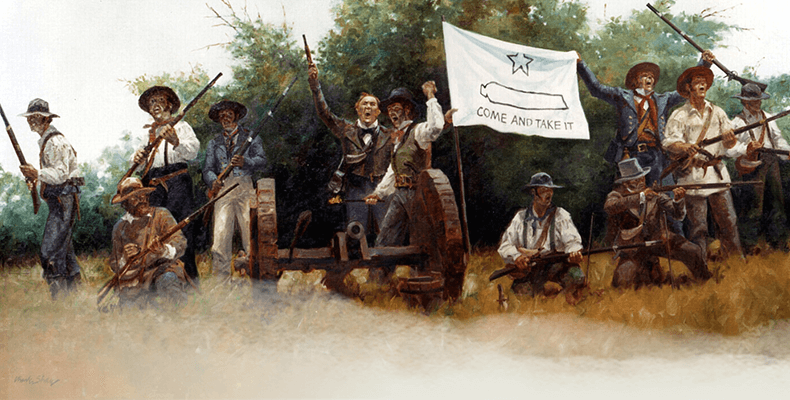
Texas Originals Tells the Texas Story From Indians to Alamo to Cowboys to Oil
Texas Originals: Real and Imagined, on display at the San Jacinto Museum of History through Labor Day 2005, contains one-of-a-kind artifacts from legendary encounters in Texas history, as well as symbolic remnants of a turbulent past.
Texas Originals tells the story of Texas, from the early Texas Indian migrations to the oil boom in the twentieth century. An Alamo collection full of highlights includes two premier artifacts, Davy Crockett’s 1819 fiddle and Sam Houston’s signature red sash. Also on display is the controversial narrative by Jose Enrique de la Peña. De la Peña's journal suggests the myth-busting possibility that Davy Crockett was captured and executed after the Battle of the Alamo, a very different picture than John Wayne’s version of swinging his rifle Old Betsy as he was fatally wounded.
In addition to the important historical content, interactive aspects are included in many areas in the Texas Originals collection. These interactive and hands-on aspects of the exhibit not only enhance the Texas Originals experience, but also bring the history of the Lone Star State to life. Visitors can climb on saddles and feel the difference between a Comanche saddle made from fur pelts and a cowboy saddle made from leather.
Visitors can touch what an ancient sandal might have felt like, as well as see the movement of Texas’ early peoples on a giant state map. The map uses fiber optics to illuminate the migrations of numerous native tribes. In contrast to the high-tech map, a hand-drawn copy of a map, originally drawn by Stephen F. Austin in 1822, shows the locations of the many different native tribes at the time. With the arrival of Austin and others, Texas slowly began to evolve into the frontier state it would become.
Today, Texas is known for the cowboy. The state has spawned one of the most notable aesthetics in recent history, with icons like John Wayne, Henry Fonda, and Clint Eastwood popularizing the dress, speech, and mannerisms of the Texan cowboy. A video component to the Texas Originals exhibit chronicles the birth of the cowboy image, beginning with the vaqueros of Spanish Texas and their influence on the cowboys that have become an international symbol of Texas culture. Notably featured in the collection, the frontier lifestyle is given new dimension by authentic artifacts such as six-shooters, spurs, and chaps from the era of the original cowboy.
For many Americans, the heroes of childhood were Wild West characters such as Buffalo Bill, Wild Bill Hickok, Wyatt Earp and others. Texas Originals gives children a chance to perpetuate his myth and to dress up like ornery Texas cowpokes themselves.
Another focus of the exhibit, the ranching history of Texas is narrated through the artifacts themselves, including numerous original branding irons. Visitors to the exhibit will get a chance to try "branding" for themselves, as part of an interactive demonstration of frontier branding. This educational and hands-on demonstration, emphasizes the importance of ranching in Texas history.
"Texas is where the big trail drives first started," said Larry Spasic, director of operations for the San Jacinto Museum of History. "Those journeys are some of the most important events ever to take place in this country."
Nowadays, one would be hard pressed to find a U.S. city without at least a few cowboy hats. The Dallas Cowboys were nicknamed "America’s Team" and the Hollywood adaptation of Texan images spawned an entire genre of film. Across the world, Texas is famous for exaggerated aspects of its culture. However, with the help of exhibits like Texas Originals, a whole new multicultural view of Texas comes into focus.
In addition to the mythic Texas cowboy image, a portion of the exhibit is devoted to another iconic image of Texans -- Texas crude and the oil patch. But as with the other thematic portions of Texas Originals, visitors will learn that there is more to the story of the Texas oil and gas boom than the J.R. Ewing of Dallas idea. Here, a more in-depth explanation can be gained about how everyday Texans, like teachers, waitresses, drilling contractors, roughnecks and others were impacted by the oil and gas boom.
Texas is indeed a land of many cultures. From the early indigenous peoples of ten thousand years ago to the rough riding heroes of yesteryear, all of them continue to contribute to the enduring spirit of Texas. Spasic may have put it best when he said, "When you travel around the country and talk to people from other states, they are proud of their state histories but as you know, as Texans we are extremely proud of our heritage.
The Texas Originals exhibit is sponsored by The San Jacinto Museum of History Association, the Kinder Foundation, HEB, and Judy and Charles Tate. Additional support is provided by Frost Bank and the Union Pacific Foundation.
Admission to the San Jacinto Museum of History is free.
Admission to the Texas Originals exhibit is $5 for adults and $3 for children.